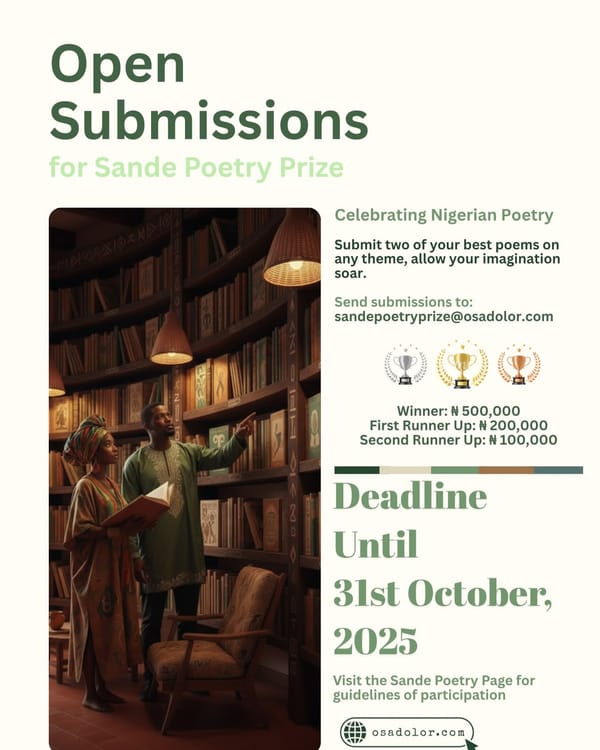
Celebrating the Winners of the Sande Poetry Prize 2025


🥇 WINNER
EXPERIMENT 12: THE THEORY OF SMALL GIRLS (Department of Endurance Studies, 2025)
by Nosawema Emmanuella Ogboghodo

Judges’ Remark
This poem claimed first place for its imaginative risk and innovative form. The poet likens the injustice that happens to the bodies of young females to an experiment undertaken in a fictitious department in a university. Even its title alludes to the masterpiece that is to follow, complete with all the scientific stages of experimentation: beginning with a hypothesis and ending with a conclusion.
The lines:
“At ten, her pelvis is still cartilage…
Bones soft with unspent girlhood…
Yet a man kneels between her thighs…
And calls it marriage”
paint a vivid picture of gender cruelty, embroiled in an act that conceals its inhumaneness beneath the umbrella of religion or culture.
While the poem whets the appetite and leaves the reader hungering for more, it delivers a result that does not disappoint:
“Result: The body can split and still be called whole.”
The author constantly reverts to scientific references and creates visceral similes with the abuse of the girl child, as seen in “Uterus folds like a lab notebook.” The conclusion alludes to the fact that there is still much unknown or undisclosed information on the subject matter, and that it is an abuse which, sadly, is yet to be eradicated.
At once, the poem is a sociocultural awakening for overlooked stories of juvenile female injustice and a poetic call to action. It is an absolutely remarkable work that leaves an indelible memory in the mind of the reader long after reading it—thus deserving of nothing but the highest accolades.
Author’s Bio
Nosawema Emmanuella Ogboghodo is a Nigerian poet and Biochemistry student whose work often explores faith, memory, and the quiet science of emotion. Influenced by the lyrical intimacy of poets such as Warsan Shire, Ada Limón, Sylvia Plath, and Ocean Vuong, she uses poetry to express thought and passion. She is drawn to imagery that bridges science and emotion, seeking meaning in the spaces between silence and song.
🥈 2nd Place
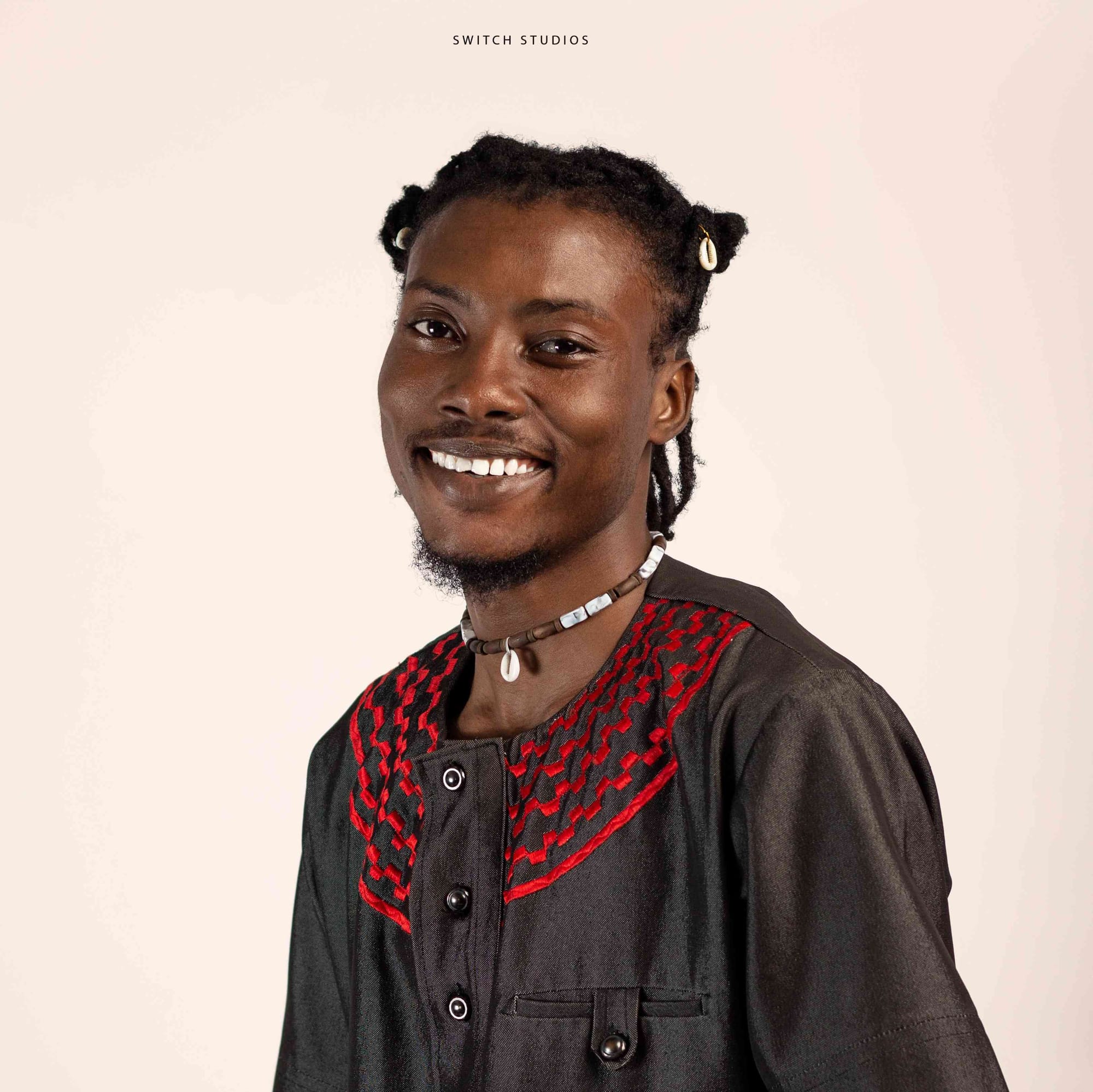
WE BLOOMED WHERE THE BOMB MISSED
by Oladosu Michael Emerald
Judges’ Remark
We Bloomed Where the Bomb Missed arrests the reader from the first line:
“A war starts, & someone plants a garden.”
The poem immediately showcases the author’s striking ability to intentionally deploy suspense—often reserved for prose and drama—through poetry. He masterfully laces the poem with emotive paradoxes that are simultaneously melancholic and bright, painting touching images of how ruin and hope coexist:
“A boy plays the cello in a ruined theatre.
A wedding happens beside the rubble.”
Beyond these paradoxes, the hyperbolic similes are otherworldly:
“A tree falls in Jos, & my chest aches like it was nearby.”
The poem’s climax earned resounding applause from the judges:
“There is a kind of defiance in hanging your clothes to dry while the sky threatens rain.”
The imagery is succinct and unforgettable. Oladosu stamps his narrative authority with such believability that the reader is compelled to revisit the poem repeatedly, relishing its brilliant, empathetic lyricism.
Author’s Bio
Oladosu Michael Emerald is a writer, digital, musical, and visual artist, photographer, and actor. He is the author of Every Little Thing That Moves and serves as an editor at Uncanny Magazine, Surging Tide, and MAAR Review. A member of the Science Fiction Poetry Association, he is a three-time Best of the Net nominee and three-time Pushcart nominee. He has won multiple awards, including the Sine Qua Non Inaugural Poetry Prize and the SprinNG Poetry Contest. He is a fellow of The Ugly Collective and a pioneer resident of both the Muktar Aliyu Art Residency and the Rongo Art Residency.
X: @garricologist · Instagram: @oladosu_michael_emerald
🥉 3rd Place
EXODUS
by Daniel Aôndona

Judges’ Remark
Exodus stood out for the poet’s ability to capture the immemorial burden of migration through haunting imagery. The poem vividly renders the anguish and uncertainty that accompany abandoning the familiarity of home for an unknown destination, all in pursuit of fulfilment.
Through stark metaphors, the poet traces the generational cyclicity of Black migration while honouring ancestral endurance:
“Before we learnt to swim through the Great Sea, our fathers had at first, mastered the drowning.”
The metaphors also depict the urgency of periodically fleeing home in order to remain functional:
“When I ask you of home, you tell me it is war,
it is a bullet chasing after its very own.
It is a graveyard for boys like us.”
The poem acknowledges that migration is driven by courage and aspiration, yet burdened by immense obstacles:
“Only that this time, the chains are tied not to our waists
but to the most tender dreams we have ever held.”
Altogether, Exodus offers a powerful meditation on migrant hope in the face of anticipated loss:
“I beg that you write my name on your chest
if the water becomes too thirsty for me.”
The judges found the poem deeply moving and contemporarily relevant.
Author’s Bio
Daniel Aôndona is a writer, graphics designer, performance poet, and arts enthusiast from Nigeria’s Middle Belt. He is a member of Hilltop Creative Arts Foundation Abuja and Oyongo Collective, and an alumnus of the SprinNG Writers Fellowship 2024. He serves as Feature Editor at Pawners Paper, Editor-in-Chief of Words-Empire Magazine, and Bluebird’s Scribe Review.
X: @aondonadaniel30 · Instagram: @daondonadaniel_30